


Neural-LAM is a repository of graph-based neural weather prediction models for Limited Area Modeling (LAM). Built on PyTorch, PyTorch Lightning, and PyG, it provides modular, swappable components for data, graphs, and models.
It is aimed at researchers and engineers working on ML-based numerical weather prediction who want to train, evaluate, or extend GNN-based LAM models on their own data.
Full guides, tutorials, and API reference live at mllam.github.io/neural-lam:
- 📦 Installation
- 🚀 Quickstart and the DANRA tutorial
- 📖 User guide: configuration and datastores, graph creation, training and evaluation, experiment logging
- 📚 API Reference
- 🗺️ Graph Storage Specification
Models, graphs, and data are kept independent so each component can be swapped without changing the others.
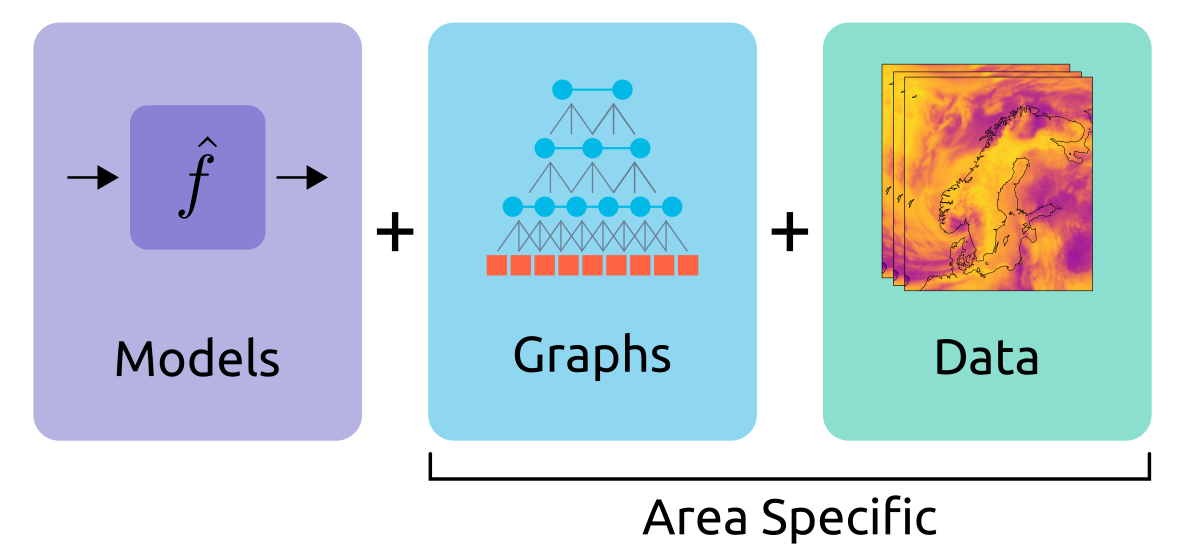
The three implemented architectures are Graph-LAM (flat), Hi-LAM (hierarchical), and Hi-LAM-Parallel. Global forecasting is available on a separate branch (planned to be merged).
# From PyPI
python -m pip install neural_lam

# From source (recommended, using uv)
git clone https://github.com/mllam/neural-lam.git && cd neural-lam
uv sync --extra cpu --group dev   # CPU
uv sync --extra gpu --group dev   # GPU / CUDA 13.0
For all install options (pip, CUDA variants, editable installs) see the Installation guide.
You need a config file, a datastore, and a graph. The Quickstart creates a graph, trains and evaluates a model from the command line on a small example dataset, and the DANRA tutorial does the same in Python with plots. The user guide covers each step in detail, including how to set up a datastore for your own data, e.g. with mllam-data-prep.
neural-lam/
├── neural_lam/           - Source code
│   ├── train_model.py    - Training / evaluation CLI
│   ├── create_graph_with_wmg.py - Graph creation CLI
│   ├── api.py            - Python API (train, evaluate, create_graph)
│   ├── models/           - Forecasting modules, forecasters, step predictors and latent encoders/decoders (see below)
│   ├── datastore/        - Datastore implementations and base classes
│   └── utils/            - Graph loading and other helpers
├── docs/                 - Documentation source (Sphinx)
│   ├── getting-started/  - Installation and quickstart
│   ├── user-guide/       - Datastores, graphs, training and evaluation, logging
│   └── notebooks/        - Marimo tutorial notebooks
└── tests/                - Test suite and example datastore configs
The model code is split into three layers:
BaseForecastingModulewraps a forecaster in the Lightning training/evaluation loop, handling optimization, logging, plotting and batch standardization. Its deterministic and probabilistic subclasses evaluate single forecasts and sampled ensembles, respectively.BaseForecastermaps initial states and forcing to a full forecast throughforwardand owns the training objective.BaseDeterministicForecasterreturns the same forecast every call;BaseProbabilisticForecastersamples a fresh one, withsample_ensemblestacking repeated samples.StepPredictoradvances the state one time step. The autoregressive forecasters (DeterministicARForecasterandBaseProbabilisticARForecaster) repeatedly apply it through the sharedunroll_forecastfunction.
A forecaster is free to produce a forecast in any way, including predicting all lead times at once; only the autoregressive versions use unrolling.
All of these are torch.nn.Module subclasses, and * marks a class that is abstract and meant to be subclassed:
nn.Module
├── pl.LightningModule
│   └── BaseForecastingModule*             - Optimizer, logging, plotting and batch standardization (neural_lam/models/modules)
│       ├── DeterministicForecastingModule - Evaluates the single forecast the forecaster produces
│       └── ProbabilisticForecastingModule - Samples an ensemble and scores its mean
├── BaseForecaster*                        - Initial states + forcing -> full forecast; owns the training objective (neural_lam/models/forecasters)
│   ├── BaseDeterministicForecaster*       - forward -> the same forecast every call; objective: a loss function applied to it
│   │   └── DeterministicARForecaster      - Unrolls that forecast; what neural_lam.train_model builds
│   └── BaseProbabilisticForecaster*       - forward -> a fresh sample each call; sample_ensemble stacks several, leaving the objective open
│       └── BaseProbabilisticARForecaster* - Unrolls each sample, still without an objective
├── StepPredictor*                         - (X_{t-1}, X_t, forcing_t) -> X_{t+1} (neural_lam/models/step_predictors)
│   ├── BaseGraphModel*                    - Encode-process-decode over a mesh graph
│   │   ├── GraphLAM
│   │   └── BaseHiGraphModel*              - Requires a hierarchical mesh graph
│   │       ├── HiLAM
│   │       └── HiLAMParallel
│   └── BaseGraphEFM*                      - Latent-variable predictors with their own prior, encoder and decoder
│       ├── GraphEFM
│       └── GraphEFMMultiScale
├── BaseLatentEncoder*                     - Grid representation -> Gaussian over a latent on the mesh (neural_lam/models/latent)
│   ├── ConstantLatentEncoder
│   ├── GraphLatentEncoder
│   └── HiGraphLatentEncoder
└── BaseGraphLatentDecoder*                - Grid representation + latent sample -> next-state increment (neural_lam/models/latent)
    ├── GraphLatentDecoder
    └── HiGraphLatentDecoder
The --model values listed in the training guide select the step predictor.
GraphEFM and GraphEFMMultiScale are implemented but not yet selectable this way.
The building blocks these are assembled from are also torch.nn.Module subclasses:
nn.Module
├── pyg.nn.MessagePassing
│   └── InteractionNet   - GNN layer, chosen per edge type with --g2m_gnn_type, --m2g_gnn_type, --mesh_up_gnn_type, --mesh_down_gnn_type (neural_lam/gnn_layers.py)
│       └── PropagationNet
├── BufferList           - List of tensor buffers held as a Module (neural_lam/utils/buffer_list.py)
└── SplitMLPs            - Feeds chunks of the input through separate MLPs (neural_lam/gnn_layers.py)
What to extend depends on the kind of model:
- Deterministic, autoregressive: write a new
StepPredictorand run it with the existingDeterministicARForecaster. This is the common case. - Deterministic, not autoregressive: subclass
BaseDeterministicForecaster, implementingforwardwith the new way of producing a forecast, reusing an existingStepPredictoror a new one if the model has a per-step component at all. - Probabilistic, autoregressive: subclass
BaseProbabilisticARForecaster, implementing the training objective, typically alongside a newStepPredictorthat samples its output. - Probabilistic, not autoregressive: subclass
BaseProbabilisticForecaster, which additionally leaves the way a single sample is produced open.
Canonical dimension names used in tensor shape annotations throughout the codebase:
B- batch sizeS- number of members in an ensemble forecastpred_steps- number of autoregressive prediction stepsnum_times- number of time steps along the time axis of a raw or batched timeseries (a trailing', e.g.num_times', denotes a pre-subsampling / pre-differencing variant)num_grid_nodes- number of nodes in the flattened spatial gridnum_boundary_grid_nodes- number of nodes in the flattened boundary spatial gridnum_mesh_nodes- number of mesh nodes; indexed asnum_mesh_nodes[l]for hierarchical levellnum_state_vars- number of atmospheric state variablesnum_forcing_vars- number of forcing input variablesnum_windowed_forcing_vars- forcing variables stacked over the past/future forcing windownum_windowed_boundary_vars- boundary forcing variables stacked over the past/future boundary windownum_variables- generic variable dimension used in metric functionshidden_dim- internal hidden representation size in GNN layers and MLPslatent_dim- dimensionality of the Graph-EFM latent variableinput_dim- input feature dimensionality to a layer before transformationnum_mesh_static_vars- number of static features per mesh nodenum_edges- number of edges in a generic edge set, e.g. in message-passing layersnum_edges_<set>- number of edges in a specific edge set,<set>being one ofg2m,m2g,m2m,mesh_up,mesh_down; indexed as e.g.num_edges_m2m[l]for the per-level lists of a hierarchical graphnum_edge_features- number of static features per edgegrid_size_x- number of grid points along the x axis of a rectilinear gridgrid_size_y- number of grid points along the y axis of a rectilinear gridnum_send- number of sender nodes in a message-passing stepnum_rec- number of receiver nodes in a message-passing step
If you use Neural-LAM in your work, please cite the relevant paper(s).
@inproceedings{oskarsson2023graphbased,
    title={Graph-based Neural Weather Prediction for Limited Area Modeling},
    author={Oskarsson, Joel and Landelius, Tomas and Lindsten, Fredrik},
    booktitle={NeurIPS 2023 Workshop on Tackling Climate Change with Machine Learning},
    year={2023}
}
See branch ccai_paper_2023 to reproduce this paper.
@inproceedings{oskarsson2024probabilistic,
  title = {Probabilistic Weather Forecasting with Hierarchical Graph Neural Networks},
  author = {Oskarsson, Joel and Landelius, Tomas and Deisenroth, Marc Peter and Lindsten, Fredrik},
  booktitle = {Advances in Neural Information Processing Systems},
  volume = {37},
  year = {2024},
}
See branches prob_model_lam and prob_model_global to reproduce this paper.
See CONTRIBUTING.md for the full contributor guide.
Join the mllam Slack or open a GitHub issue to get in touch.