
Run commands like linters and formatters on staged git files.
- Safe. Partially staged files are three-way merged, so a conflicting edit never aborts your commit.
- Universal. A single binary with no runtime - the same tool in Node, Python, Go, Rust or a polyglot monorepo.
- Fast. Written in Rust, it is 5 to 30 times faster than pre-commit, lint-staged, Lefthook and nano-staged.
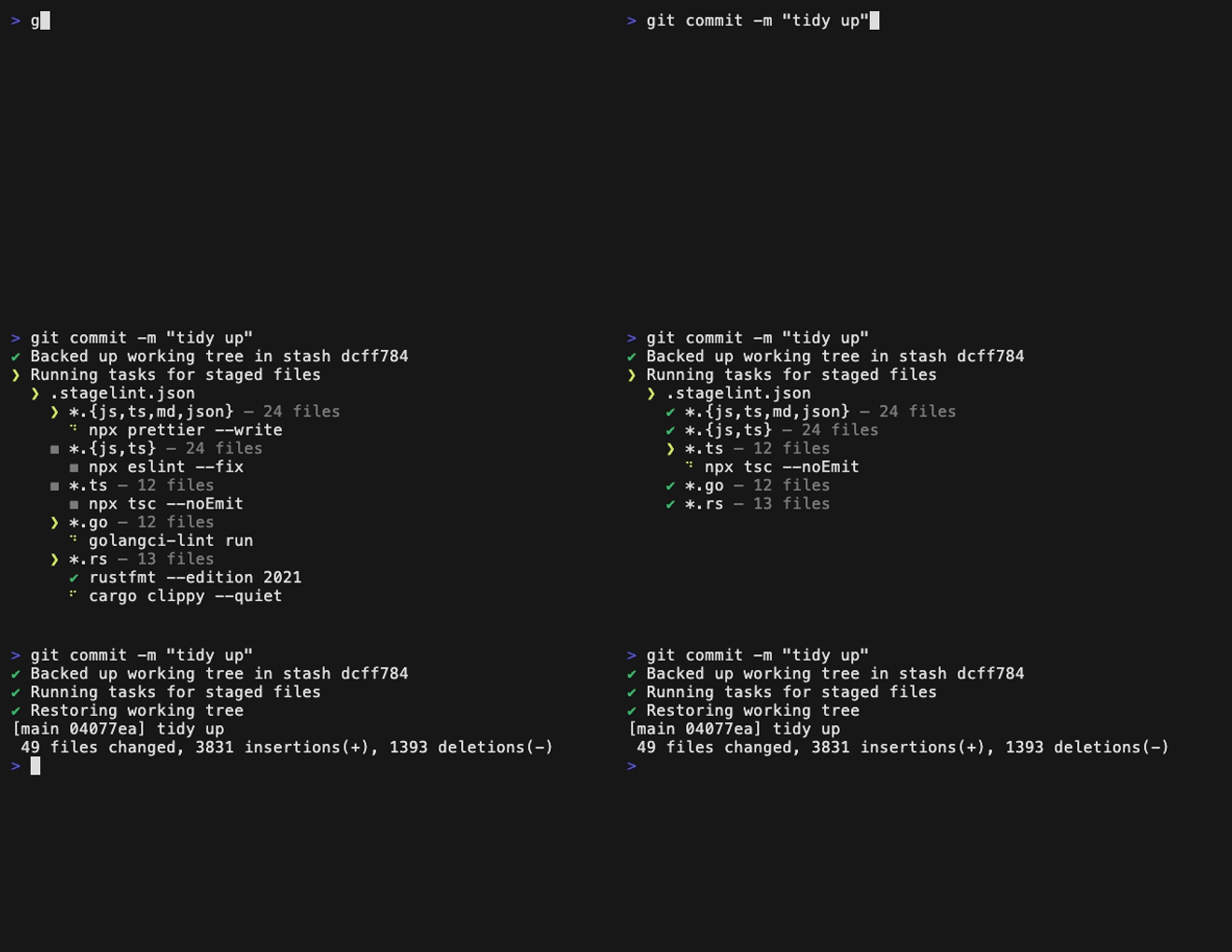
Running formatters before a commit is easy until you stage part of a file. You stage the hunks you want and leave the rest in your working tree - a debug line, a half-finished function. A formatter rewrites the whole file, so its output has to be reconciled with your unstaged changes. Most tools give up and abort the commit or, worse, commit them along with the fix.
stagelint stashes the unstaged edits, runs your commands, then three-way merges the result. What you staged gets formatted, what you did not stays exactly where you left it, and the commit goes through either way.
npm install --save-dev @stagelint/stagelintIf you do not already use a hook manager, add the hook to your prepare script so it installs
itself for the whole team:
{
  "scripts": {
    "prepare": "stagelint init"
  }
}pipx install stagelintDownload a prebuilt binary using cargo-binstall:
cargo binstall stagelintOr compile it from source:
cargo install stagelintgo install github.com/abemedia/stagelint@latestdotnet tool install -g stagelintbrew install abemedia/tap/stagelintDownload, verify and install a prebuilt binary:
curl -fsSL https://stagelint.dev/install.sh | shIt installs to /usr/local/bin when that is writable, otherwise to ~/.local/bin. Set
STAGELINT_INSTALL_DIR to choose the directory, or STAGELINT_VERSION to install a specific
version.
See the installation docs for more ways to install stagelint, including APT, DNF, Pacman, Scoop, Nix and mise.
If you already use a hook manager like pre-commit, Lefthook, or husky, call stagelint from its
configuration rather than running stagelint init. See the
hook manager docs for how to set up each one.
stagelint initThis creates .git/hooks/pre-commit (or respects core.hooksPath). Use --force to overwrite an
existing hook.
Pass any CLI flag after -- for the hook to run stagelint with:
stagelint init -- --stash trackedSee the CLI reference for the full list of supported flags.
Create .stagelint.yml, .stagelint.yaml, .stagelint.json, .stagelint.jsonc, or
.stagelint.json5 in your project root. The format is a map of glob patterns to commands:
# .stagelint.yml

# String: single command, files appended as args
'*.md': 'prettier --write'

# Object: control whether files are passed
'*.go':
  command: 'go vet ./...'
  pass_filenames: false

# Array: sequential commands, each a string or an object
'*.ts':
  - eslint --fix
  - command: 'tsc --noEmit'
    pass_filenames: false
Matching files are always appended as arguments unless pass_filenames: false is set. Commands run
from the directory of the config file that declared them, and receive absolute paths.
Negation patterns such as !(*.ts) are not supported, and match nothing rather than failing, so a
task configured with one never runs.
Commands are split using POSIX shell rules on all platforms, so quote any argument containing spaces or backslashes.
Place config files at any level in the repo. Each staged file uses the closest config file walking up toward the root.
Commands resolve to the tools installed in your project, so there is no need for npx or uv run.
Any node_modules/.bin, .venv/bin (.venv/Scripts on Windows) or vendor/bin directory in the
config file's directory, or in any directory above it up to the repository root, is added to PATH.
The same config runs over a coding agent's edits and hands failures back for the agent to fix. For
Claude Code, add this to .claude/settings.json:
{
  "hooks": {
    "Stop": [
      {
        "hooks": [
          {
            "type": "command",
            "command": "stagelint --unstaged --quiet || exit 2"
          }
        ]
      }
    ]
  }
}
See the agent hook docs for how to set up other agents.
Check every pull request, including commits that skipped the hook. In GitHub Actions, add the stagelint action to a workflow:
name: stagelint

on:
  pull_request:
  push:
    branches: [main]

permissions:
  contents: read

jobs:
  stagelint:
    runs-on: ubuntu-latest
    steps:
      - uses: actions/checkout@v7

      # Install the tools your stagelint config runs.

      - uses: abemedia/stagelint-action@v1
See the CI docs for the action's options and instructions for other CI providers.
Each cell is fully staged / partially staged, measured on a 1,000-file repository with a no-op
task, on a 2019 MacBook Pro (Intel Core i9-9880H).
| Staged files | stagelint | Lefthook | nano-staged | lint-staged | pre-commit |
|---|---|---|---|---|---|
| 10 | 15ms / 30ms | 152ms / 373ms | 224ms / 311ms | 437ms / 530ms | 450ms / 525ms |
| 100 | 19ms / 76ms | 163ms / 537ms | 249ms / 425ms | 455ms / 672ms | 486ms / 612ms |
Partial staging is the expensive path, and the only one where a tool has to hide your unstaged edits
and restore them afterwards. On a commit where prettier takes two seconds this is noise; it matters
on small commits and fast formatters, which is most of them. Reproduce with bench/run.sh.
- lint-staged - Inspired the configuration format and overall workflow.
- git-format-staged - Inspired the concept of formatting staged content and merging it back without blocking commits.