

🌐 Company Site - Here
🤗 Hugging Face - Here
📚 Help Center - Here
🐳 Docker Hub - Here
- Docker (recommended):
docker pull faceplugin/face-liveness:latestthendocker run— Option A - Or local: download CPU runtime into
lib/cpu/— Option B, then./run.sh— API on 8084 - Confirm it is running:
curl -s http://127.0.0.1:8084/api/health(no license needed yet) - Contact us with your machine code to obtain a license key, then activate with
POST /api/activate— Activate your license - Try it: Postman, curl, or local Gradio demo on 9004 (
python3 demo.py)
Docs: doc.faceplugin.com
Try online: Hugging Face Space
FacePlugin Face Liveness SDK is a fully on-premise anti-spoofing engine for Linux and Docker. It scores a single RGB face image for presentation attacks, such as printed photos, screens, printouts, and video replay, and returns Real / Spoof with a pass score.
The SDK supports KYC and remote identity verification workflows, and is built for banking, eKYC, and on-premise compliance. All processing runs on your own server, and no images or biometric data are ever sent to FacePlugin.
The SDK runs as a REST API server on Linux (x86_64), or through Docker on Linux, Windows, and macOS (Apple Silicon uses amd64 emulation). It runs on CPU only. This repository is self-contained, with no other FacePlugin repository required.
| Feature | API |
|---|---|
| RGB face liveness (all engines combined) | POST /api/liveness · sdk.liveness |
| Photo, screen, print, and replay presentation-attack detection | same call |
| Score, Real/Spoof, pass | data.score · data.result · data.pass |
| Health / machine code / activate | GET /api/health · GET /api/machinecode · POST /api/activate |
| License capabilities | GET /api/licenseStatus · sdk.get_license_status |
Score ≥ 0.5 → result: "Real", pass: true. Score < 0.5 → result: "Spoof", pass: false.
POST /api/check_liveness is an alias of /api/liveness.
| Platform | Repository |
|---|---|
| Android (Recognition) | FaceRecognition-Android |
| iOS (Recognition) | FaceRecognition-iOS |
| React Native (Recognition) | FaceRecognition-React-Native |
| Flutter (Recognition) | FaceRecognition-Flutter |
| Ionic Capacitor (Recognition) | FaceRecognition-Ionic-Capacitor |
| Ionic Cordova (Recognition) | FaceRecognition-Ionic-Cordova |
| Windows (Recognition) | FaceRecognition-Windows |
| Linux / Docker (Recognition) | FaceRecognition-Docker |
| Android (Liveness) | FaceLivenessDetection-Android |
| iOS (Liveness) | FaceLivenessDetection-iOS |
| Windows (Liveness) | FaceLivenessDetection-Windows |
| Linux / Docker (Liveness) | FaceLivenessDetection-Docker (this repo) |
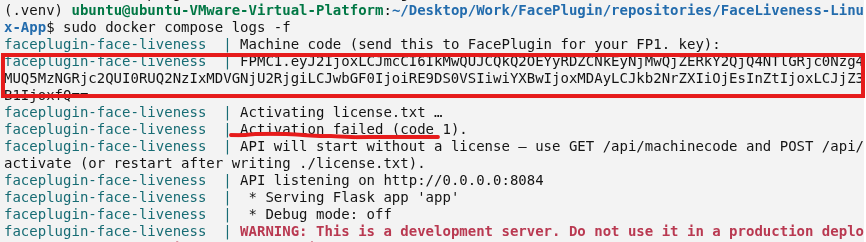
You do not need a license to start the API. The server prints your machine code on startup, which you'll need to activate your license. Product endpoints unlock after you activate.
| Item | Minimum | Recommended |
|---|---|---|
| CPU | 2 cores | 4 cores |
| RAM | 4 GB | 8 GB |
| Disk | 4 GB | 8 GB |
| OS (Docker) | Linux + Docker Engine | Ubuntu 22.04 / 24.04 |
The runtime is already inside the image, so no Google Drive download is needed.
sudo docker pull faceplugin/face-liveness:latest
sudo docker run -d --name faceplugin-face-liveness \
  --shm-size=1gb --privileged \
  -p 8084:8084 \
  -v /etc/machine-id:/etc/machine-id:ro \
  faceplugin/face-liveness:latest
sudo docker logs -f faceplugin-face-liveness
# Look for the machine code line in the logs
On Docker Desktop (macOS/Windows) omit the /etc/machine-id volume.
To run multiple containers on one Linux host with a shared machine code / license, see the docs:
This option runs the server directly on your machine. It requires glibc 2.38 or newer (for example, Ubuntu 24.04). Check your version with ldd --version. No GPU is needed; this product runs on CPU only.
git clone https://github.com/Faceplugin-ltd/FaceLivenessDetection-Docker.git
cd FaceLivenessDetection-DockerThe lib/cpu/ folder is empty on GitHub because the native libraries and model files are too large to host there.
- Open the FaceLiveness Linux runtime folder on Google Drive.
- Download every file in the folder.
- Place the files directly in
lib/cpu/, not in a subfolder.
Your project should look like this:
FaceLivenessDetection-Docker/
└── lib/
    └── cpu/
        ├── libFaceLivenessSDK.so
        ├── libfal-eng.so
        ├── fal.fpk
        └── ... (remaining files from Google Drive)
⚠️ If Google Drive gives you a zip, extract it and move the files up so you don't end up withlib/cpu/SomeFolder/libFaceLivenessSDK.so.
pip3 install -r requirements.txt
./run.sh
The API starts at http://127.0.0.1:8084, and the machine code is printed in the terminal. Continue with Activate your license.
Licenses work offline and are tied to the machine code of the environment where the server runs. Offline cryptography is built into the SDK, so no OpenSSL install is needed.
⚠️ Docker and local installs have different machine codes. Get the machine code from the same environment you'll use in production. If you'll run in Docker, send the code from the Docker container, not from the host.
-
Start the server using Docker Hub or
./run.sh(see Start the API). You don't need a license for the first start. -
Get your machine code. It's printed in the startup log, or you can fetch it with
GET /api/machinecode. -
Send the machine code to FacePlugin (contact us). We'll reply with a license key for that machine code.
-
Activate the license. Save the license key to
license.txtin the project root, replacing anything already in the file. Then send it to the running server:curl -s -X POST http://127.0.0.1:8084/api/activate \ -H 'Content-Type: text/plain' \ --data-binary @license.txtIf you run in Docker, this command is required, because detached containers don't re-read
license.txtafter they start. The same command also works with./run.sh.

After activation, GET /api/licenseStatus reports what the key unlocks. The Gradio demo shows the same summary as License: at the top of the page.
This App exposes liveness APIs only. Typical labels:
- Liveness only / Recognition + Liveness —
/api/liveness - Recognition only — liveness stays unavailable on this App
- Not licensed — machine code only until you activate
Check status anytime:
curl -s http://127.0.0.1:8084/api/licenseStatuscurl -s http://127.0.0.1:8084/api/healthcurl -s -X POST http://127.0.0.1:8084/api/liveness \
-H 'Content-Type: application/json' \
-d '{"image":"<base64-jpeg>"}'Success data:
{ "score": 0.72, "result": "Real", "pass": true }Import postman/FaceLiveness-API.postman_collection.json.
Default base URL: http://127.0.0.1:8084
The Docker image includes only the API server, not the demo UI. To view results in your browser, run the Gradio demo on your own machine. Make sure the API is already running on port 8084 first.
pip3 install -r requirements-demo.txt
DEMO_PORT=9004 API_BASE=http://127.0.0.1:8084 python3 demo.py
Open http://127.0.0.1:9004 in your browser. Sample images, if included, are in assets/examples/samples/. The page header shows your current license status, taken from /api/licenseStatus.
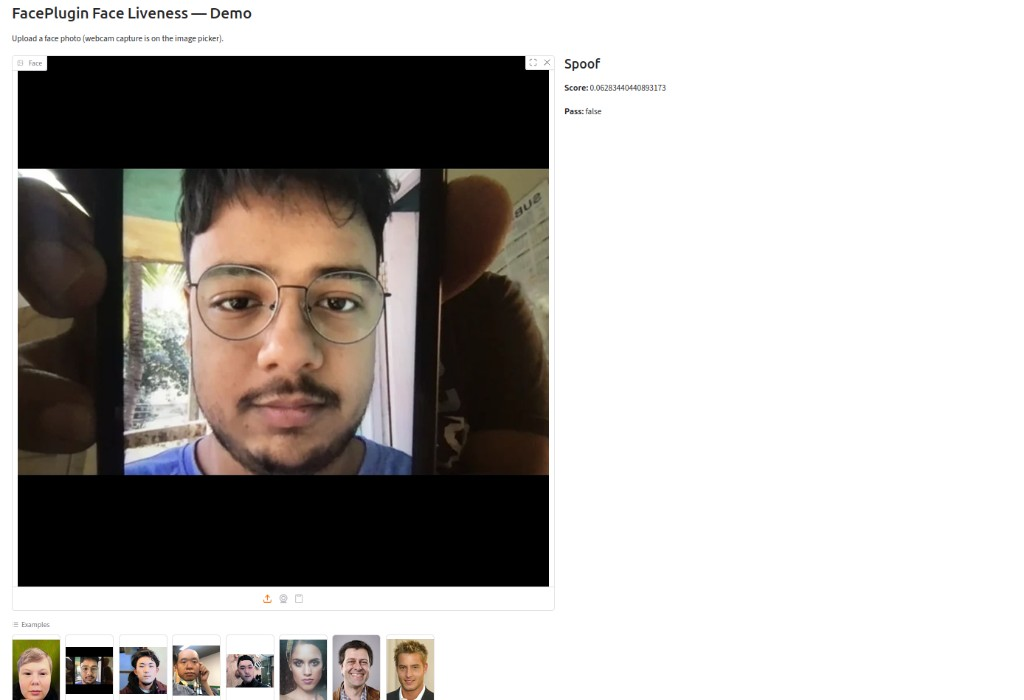
Each run shows Score, Result (Real or Spoof), and Pass for presentation-attack detection.
Two paths. You do not need the Gradio demo (demo.py) in production; it is a host-only test UI.
HTTP (any language) — start the API (see Start the API) and keep it running, then POST /api/liveness with {"image":"<base64-jpeg>"}. See the Liveness example, the Postman collection, and doc.faceplugin.com for the full protocol.
Python in-process — on the same Linux host as lib/cpu/ (or inside the container), copy sdk.py + lib/cpu/ into your project (or import sdk from this repo) and call the SDK directly, with no HTTP hop. See About SDK.
Use the Python bindings in sdk.py. Return code 0 means success.
import sdk

machine_code = sdk.get_machine_code() # machine code
sdk.activate("license.txt")
sdk.init_sdk()
result = sdk.liveness(base64_image)
result is JSON. data is { "score": <float>, "result": "Real" | "Spoof", "pass": <bool> }. All RGB engines are always run and combined.
HTTP endpoints: /api/health, /api/machinecode, /api/licenseStatus, /api/backend, /api/activate, /api/liveness, /api/check_liveness.
Request a license, machine-code activation (machine code → license key), or integration help:


