

The files your agents follow, checked every time.
Your AI coding agent reads CLAUDE.md, AGENTS.md, rules, skills, hooks and MCP configs before it reads a line of your code, then does what they say.
Agent.md checks them (26 deterministic checks), keeps the hard rules through compaction, turns "never" lines into real deny rules, and guards what the agent runs: every install, and every irreversible call.
Any repo. Ten seconds. No account. Nothing uploaded.
npx activate-agentmd audit your/repo



The problem · What it does · Every time · Quick start · Why it's different · Research · CI · FAQ

Real output, on a small example repo:
  Agent context audit  acme-app
  2 files an agent reads · ~52 tokens loaded on every prompt

     1  secrets in files the agent reads
     1  prompt-injection signals
     1  dangerous patterns in 1 skill script
     1  references to files that no longer exist
     1  formatting rules a formatter already enforces  auto-fixable

  ERROR   .claude/skills/deploy/scripts/run.sh:2  skill-payload
          Downloads code and pipes it straight into a shell.
  ERROR   CLAUDE.md:4  secret
          Looks like an Anthropic API key. Instruction files are sent to the model on every session.
  ERROR   CLAUDE.md:6  injection
          An HTML comment carries an instruction. GitHub hides comments from reviewers but the agent reads them.
  WARNING CLAUDE.md:3  stale-reference
          `src/auth/middleware.ts` does not exist in this repository. The agent will look for it and guess.
| Command | What it does |
|---|---|
npx activate-agentmd audit owner/repo |
Check any public GitHub repo, without cloning it |
npx activate-agentmd lint |
Check your own repo. Exits non-zero in CI; SARIF for code scanning |
npx activate-agentmd init |
Attach to the agents in this project, once: compile the "never" lines into Claude Code and Codex controls, install the hooks, and attach the runtime guard to Claude Code, Gemini CLI and Cursor |
npx activate-agentmd memory on |
Opt in, per project: an action the guard already refused twice is blocked, not paused again |
npx activate-agentmd demo |
Two minutes, offline: the guard pauses a production volume delete, signs the refusal, and refuses what an AGENTS.md forbids, citing the line |
npx activate-agentmd lint --fix |
Delete what only costs tokens, and tell the agent to follow the code when a file drifted from it |
npx activate-agentmd guard --install |
Block typosquats, untrusted indexes and vulnerable pins before the agent's pip / npm install runs |
npx activate-agentmd pin --install |
Keep the hard rules in context through compaction: they come back after every /compact and resume |
npx activate-agentmd enforce --write |
Turn "never do X" lines into permission deny rules, and see which rules are still prose only |
npx activate-agentmd learn |
The corrections you keep giving your agent, and the refusals it keeps hitting, proposed as rules; --pr opens them as a pull request |
npx activate-agentmd broker run --aws -- claude |
Run the agent with short-lived credentials and your long-lived logins out of reach (AWS, GitHub App, GCP, Azure) |
npx activate-agentmd digest |
One message on the last 7 days: what the guard stopped, rules learned, rules in force, broker runs, lint |
npx activate-agentmd verify receipt.json |
Who signed a guard refusal or a context bundle, and whether it is intact |
npx activate-agentmd cost |
What your always-on context costs per developer per month, and what --fix gives back |
npx activate-agentmd sbom --out bom.json |
Context bill of materials (CycloneDX 1.6): every file, skill, script, hook, MCP server and grant an agent loads, hashed |
npx activate-agentmd ci --write |
All of it on every pull request, as one GitHub Actions workflow |
npx activate-agentmd init --presets |
Optional: version notes and engineering standards for your exact stack |
It reads CLAUDE.md, AGENTS.md, GEMINI.md, Cursor and Copilot rules, every SKILL.md and the scripts beside it, subagents, hooks, memory files and MCP configs, for Claude Code, Cursor, Codex, Copilot and Gemini CLI. Free, open source, runs locally. Precision first: findings on the instruction files of 146 real-world repositories, every reference finding checked by hand, plus 4,292 registry files and 272 skill scripts; precision is re-checked on 72 of those repositories before each release. What it cannot see: docs/KNOWN-LIMITS.md.
Every coding agent reads a rules file first, on every prompt, and trusts it more than your code. Nobody reviews those files like code, and nothing enforces what they say.
In 320 runs across 40 projects, 90.1% of agent choices followed an outdated instruction file over the existing code. Claude Code noticed the conflict in 79 of 80 runs and followed the file anyway. One sentence telling the agent to prefer the code raised code-following from 4.2% to 91.4% (arXiv 2610.30571).
- After a session compacts, violations of the project's own rules go from 0% to 30–59% (arXiv 2606.22528). Claude Code now re-reads the root
CLAUDE.mdafter/compact; nested files and path-scoped rules come back only on demand (Claude Code docs). - In 481 public
CLAUDE.mdfiles, only 4.4–16% of security rules have a control that enforces them (arXiv 2608.23550). "Never force-push" is advice until something refuses the command.
- ~0.7% of public agent instruction files contain a live credential, mostly pasted by hand (Radware, Aug 2026), and mainstream secret scanners don't watch these files.
- Shared rule files make agents install look-alike packages with 79% success across 8 agents and 13 models (arXiv 2610.09264); editing only a README or requirements file makes agents pull from attacker indexes (authors at Microsoft, arXiv 2607.15143).
- Rule files are a working prompt-injection channel (Aletheia, 2026); skill scanners stop at
SKILL.md, and Trail of Bits bypassed every one it tested (CSA / Trail of Bits).
- Agent instruction files grow +226% over their lifetime, and noisy instructions cut instruction-following by 24 points (arXiv 2608.11095).
- 91 of the 100 most-starred repos have at least one configuration smell: leaked lint rules, bloat, dead references, contradictions, never-edited
/initoutput (arXiv 2606.15828).
The fix: check every file the agent reads like you check code, keep the rules in context, turn the "never" lines into controls, and gate the installs. Every time, not once.
| Feature | The pain it removes | |
|---|---|---|
| 🔒 | lint / audit: 26 deterministic checks on every file an agent reads: leaked keys, prompt injection, invisible Unicode, hidden HTML-comment instructions, look-alike packages, untrusted install sources, unpinned MCP servers, shell-wide permission grants, contradictions, file-vs-code drift, duplicate skills, bloat, dead references, stale pins. --fix deletes what only costs tokens. Exit 1 in CI; SARIF for code scanning. |
Secrets, injected instructions and poisoned setup steps reaching the model; files that drifted from the code |
| 📌 | pin: a Claude Code SessionStart hook that re-injects the hard rules after every /compact and resume, inside a token budget you set. |
Rules that disappear halfway through a long session |
| ⛔ | enforce: compiles one-reading "never" lines (force-push, push to main, rm -rf, editing .env, sudo, publish, terraform, kubectl, curl | sh …) into permissions.deny, and reports what stays prose. --check fails CI on a gap. |
"Never" that nothing enforces |
| 🚦 | Runtime guard (attached by init): a hook before every tool call in Claude Code, Gemini CLI and Cursor. Irreversible actions (force-push, dropping a database, deleting a volume) pause for a person; the project's own "never" lines are refused, citing the line; look-alike package installs pause with no network; every refusal is signed. No model in the loop. |
An agent doing the one thing the file said never to do |
| 🛡 | guard: a pre-install gate for the agent's own pip / npm / uv commands: typosquats, separator confusion, untrusted --extra-index-url and registries, plain-HTTP indexes, hidden directives in requirements files, known-vulnerable pins (OSV). |
Agents install from an untrusted index almost unconditionally |
| 🧠 | learn and memory: learn reads your own local session logs for the corrections you keep giving ("use pnpm", "don't touch the migrations") and the guard's repeated refusals, and proposes them as rules, locally or as a pull request (--pr). Nothing is kept without you. memory on blocks an action refused twice in the project, and never refuses anything else. |
Repeating yourself to the agent every day |
| 🔑 | broker: starts the agent with short-lived, narrowed credentials (AWS session policy, one-repo GitHub App token, GCP impersonation, Azure access token) and its long-lived logins (~/.aws, ~/.ssh, ~/.config/gh …) out of reach. |
An agent holding the keys to production |
| 🗞 | digest: one Markdown message for Slack, an email or a PR, from local logs only: what the guard stopped, rules learned, rules in force per agent, broker runs, lint findings. |
"What did the agents do this week?" |
| 💸 | cost: what your always-on context costs per developer per month, per agent. --budget fails a PR that pushes it over your limit. |
Context that only grows |
| 📋 | sbom: a context bill of materials in CycloneDX 1.6: every instruction file, rule, skill and script, subagent, hook, MCP server and permission grant, hashed. |
"What was this agent loading?" has no answer today |
| ⇅ | Version pins + checks: reads the majors you actually run and puts their breaking changes in the agent's context; 15 deterministic checks across 13 libraries catch the old API in the diff. | Deprecated code that compiles, passes review, and breaks later |
| ✍️ | Signed context bundles and receipts: sign the exact set of instruction files your team approved with your own Ed25519 key; CI fails on any change. Bundles and guard refusals share one receipt format, and verify says who signed one. |
Unreviewed rule changes; a refusal nobody can check |
| 📚 | 300+ engineering standards, on demand: security, backend, database, frontend, API, testing, DevOps, motion design and more, loaded only when the agent works in that area. | Re-writing the same 400-line rules file in every repo |
A linter you run once is a one-time fix. These files are read on every prompt, so Agent.md sits on the moments they fail:
flowchart LR
    S([Session start / compaction]) -- pin re-injects the hard rules --> A[Your agent]
    T([Every tool call]) -- the runtime guard pauses irreversible calls and refuses forbidden ones --> A
    I([Every install the agent runs]) -- guard blocks look-alikes and bad indexes --> A
    N(["Every 'never' line"]) -- enforce compiles it to a deny rule --> A
    C([Every correction you repeat]) -- learn proposes it as a rule --> F[(CLAUDE.md · AGENTS.md · rules · skills)]
    F -- read on every prompt --> A
    P([Every pull request]) -- lint · enforce --check · cost --budget --> F
    R([Every dependency bump]) -- stale pins · drift · dead paths --> F
| Moment | Command | What happens |
|---|---|---|
Session start, /compact, resume |
pin --install |
the hard rules come back into context |
The agent runs git push --force, drops a database, deletes a volume |
init |
the runtime guard pauses it for a person and signs the refusal; with memory on, the third try is blocked |
The agent runs pip install / npm install |
guard --install |
look-alikes, untrusted indexes and vulnerable pins are blocked, with the reason |
| You write "never …" | enforce --write |
it becomes a deny rule the harness applies |
| You correct the agent twice, or the guard refuses the same call three times | learn |
it is proposed as a rule; --pr opens it for review |
| Every Monday | digest |
what the guard stopped and what was learned, in one message |
| A pull request touches the files | ci --write |
lint, enforce coverage and a token budget, in one workflow |
| A dependency or a path changes | lint |
stale pins, drift and dead references fail the check |
1. Check every file your agent reads: works on any repository, nothing to install first
npx activate-agentmd lint ERROR CLAUDE.md:14 secret
Looks like an Anthropic API key. Instruction files are sent to the model on every session — rotate it, then read it from the environment.
ERROR .cursor/rules/deploy.mdc:3 injection
An HTML comment carries an instruction. GitHub hides comments from reviewers but the agent reads them.
WARNING CLAUDE.md:1 stale-pins
The version pins in the agentmd block do not match the dependencies this project now runs.
2 errors, 1 warning across 6 instruction files
2. Attach the runtime guard, and gate every install the agent runs
npx activate-agentmd init               # runtime guard on Claude Code, Gemini CLI and Cursor; "never" lines compiled
npx activate-agentmd guard --install    # the install gate, online checks included
npx activate-agentmd demo               # two minutes, offline: see it pause and refuse
3. Keep the rules, and make "never" real
npx activate-agentmd pin --install      # hard rules survive /compact and resume
npx activate-agentmd enforce --write    # "never" lines become permissions.deny
Enforcement 6 hard rules · 5 prohibitions · 4 enforceable · 0 enforced · 2 left to the model
! prose only CLAUDE.md:3 Never force-push.
force pushes: Bash(git push --force:*), Bash(git push -f:*), Bash(git push --force-with-lease:*)
! prose only CLAUDE.md:4 Never edit `.env`.
edits to `.env`: Edit(./.env)
! 9 deny rules would make the prose above enforced. `agentmd enforce --write` adds them to .claude/settings.json.
4. See what your context costs, and what it loads
npx activate-agentmd cost
npx activate-agentmd sbom --out bom.json
5. Detect the stack, pin breaking changes, install standards
npx activate-agentmd init --presets
npx activate-agentmd link
✓ Next.js package.json (next)
✓ PostgreSQL package.json (pg)
⇅ Next.js 16 node_modules (next 16.0.3) (version pin)
⇅ Prisma 7 package.json (@prisma/client ^7.0.0)
Recommended packages for claude:
Security authentication, owasp, sql-injection
Database postgres, prisma, indexes, migration
Install these? [Y/n]
link writes a managed block into whichever of CLAUDE.md, AGENTS.md, .cursor/rules, GEMINI.md and copilot-instructions.md your tools read. Commit .agentmd/ and the whole team gets the same rules.

6. Check a diff: deterministic, offline, zero tokens
npx activate-agentmd review --fast --fail-on=high
Or try it in the browser in 10 seconds at agentmd.tech/inspect: drop a package.json to see every major your agent will get wrong, or paste a CLAUDE.md to check it. Nothing is uploaded.
| Attempt | What Agent.md does |
|---|---|
Paste an API key into CLAUDE.md |
secret error; the key is never echoed; the PR check goes red |
| Hide an instruction in an HTML comment | injection error (GitHub hides comments from reviewers, the agent reads them) |
Add pip install reqeusts to a setup step |
package-swap error in lint; the runtime guard pauses it offline; guard blocks it; --online asks PyPI whether the name exists |
Have the agent git push --force when AGENTS.md says never |
the runtime guard refuses it, cites the line, and signs the refusal |
| Have the agent approve its own refusal, or turn memory off | refused: only a person at a terminal can run agentmd allow or memory off |
| Hand over a receipt signed with someone else's key | verify fails: the key is not where the claimed signer keeps theirs |
Point installs at --extra-index-url http://… |
install-source error; guard blocks it |
| Write "never force-push" and hope | enforce adds Bash(git push --force:*) to permissions.deny; the harness refuses it |
Run a long session until /compact drops the rules |
pin re-injects them on SessionStart |
Move a file and leave CLAUDE.md pointing at the old path |
stale-reference, with where the file is now |
Tell the agent "use 4 spaces" when .editorconfig says tabs |
code-drift; --fix adds the precedence sentence |
| Ship two skills with the same name in one folder | skill-conflict: the agent would load one at random |
npx -y some-mcp-server@latest in an MCP config |
mcp-unpinned |
| Edit an approved instruction file without sign-off | bundle verify fails CI |
| Grow the always-on file a little every week | accretion reads git history; cost --budget fails the PR that crosses your limit |
| Agent.md | Hand-written CLAUDE.md |
Skills marketplaces | Docs retrieval (Context7) | Code review bots | |
|---|---|---|---|---|---|
Lints CLAUDE.md / AGENTS.md / rules / skills for secrets, injection and drift |
✅ 26 checks | ❌ | SKILL.md only |
❌ | ❌ |
| Rules survive compaction | ✅ pin |
❌ | ❌ | ❌ | ❌ |
| "Never" lines become enforced controls | ✅ enforce |
❌ | ❌ | ❌ | ❌ |
| Gates the agent's own installs | ✅ guard |
❌ | ❌ | ❌ | ❌ |
| Breaking changes for your installed majors, in context before the agent writes | ✅ | ✋ by hand | ❌ | ❌ | |
| Signed, approved context with an audit record per commit | ✅ | ❌ | ❌ | ❌ | ❌ |
| Works across Claude Code, Cursor, Codex, Gemini CLI, Copilot | ✅ 5 | ❌ 1 | ✅ via MCP | ||
| Runs offline, no account, no API key for the core | ✅ | ✅ | ❌ | ❌ | |
| Open source | ✅ MIT (the CLI; the runtime guard binary is proprietary) | n/a | ❌ mostly |
Built to be trusted:
- Neutral across vendors. One tool for the files every agent reads, signed with your key, not any vendor's.
- Deterministic, not model-judged. Every rule has a must-catch and a must-not-fire sample, tested in CI, and every new rule is diffed on real repositories before it ships. A gate that cries wolf gets switched off.
- Evidence-first. A check, a pin or a standard ships when it is measured, not when it sounds right.
| Finding | What Agent.md does |
|---|---|
| 90.1% of agent choices followed a stale instruction file over the code; one precedence sentence fixed most of it (arXiv 2610.30571) | code-drift flags a file that disagrees with .editorconfig or the test runner you install; lint --fix adds the precedence sentence |
| Rule violations rise from 0% to 30–59% after compaction (arXiv 2606.22528) | pin --install re-reads the hard rules after every compaction and resume |
| Only 4.4–16% of security rules in instruction files have an enforcing control (arXiv 2608.23550) | enforce compiles "never" lines into deny rules and shows the coverage |
| Turning repeated corrections into rules, kept only when they measurably help, is where the gain comes from (arXiv 2610.14216) | learn proposes rules from the corrections you repeat; you decide what stays |
| Generic always-on context files give no gain in task success at 20%+ more cost; repository overviews don't help (ETH, arXiv 2602.11988) | Only version pins are always on. Standards load on demand; redundant-overview flags sections copied from the README |
| Version-specific API facts help; naming the version alone doesn't (LibEvoBench) | Pins state the changed API, read from what is actually installed |
| Compliance dilutes as instructions pile up; curators append and never delete (arXiv 2610.11007) | accretion flags files that only ever grew; cost --budget caps always-on tokens in CI |
| Shared rule files carry package hallucination attacks with 79% success; detectors miss most or cry wolf (arXiv 2610.09264) | package-swap is deterministic; --online asks npm and PyPI whether a name exists |
| A deterministic pre-install hook closes 10 of 11 install-time attack scenarios (authors at Microsoft, arXiv 2607.15143) | guard is that hook, plus install-source in lint so the poisoned line is caught at review time too |
| 15.4% of 2,660 public agent setups (in 3,171 repos) carry an unpinned MCP package or a broad execution grant (Red Hat, arXiv 2609.07360) | mcp-unpinned, permissions, skill-preapproval; sbom lists every server and grant with its pin state |
| 57% of contradictions flagged by an LLM judge were real; the rest were noise (arXiv 2606.15828) | conflict only fires on exact opposite-polarity pairs and lockfile mismatches |
| Skills spread by copying with no version or provenance (arXiv 2610.11169) | sbom hashes every skill and script so a copy can be matched to its source; skill-conflict catches duplicates |
| Severity | Rule | Catches |
|---|---|---|
| error | secret |
Anthropic, OpenAI, GitHub, AWS, Slack, Stripe, Google keys; private keys; long values assigned to secret names. Placeholders are ignored; the secret is never echoed. |
| error | injection |
"ignore previous instructions", permission-bypass flags, zero-width / bidi / tag characters, instructions hidden in HTML comments, hooks that pipe a download into a shell |
| error · warning | skill-payload |
skill scripts that pipe a download into a shell, eval decoded data, serialise the environment or read credential stores while calling out |
| error · warning | install-source |
--extra-index-url, --index-url, --registry or --trusted-host pointing anywhere but the ecosystem's registry, plain-HTTP indexes, hidden directives in requirements.txt, PIP_CONFIG_FILE redirection |
| error · warning | package-swap · package-missing |
an install or a rule that names a typosquat of a package you install or of a widely used one (reqeusts, lodahs, crossenv, @anthropic/sdk). With --online (on by default in audit) npm and PyPI are asked: a name nobody has registered is an error (slopsquatting), and an established package is never flagged |
| warning | code-drift 🆕 |
an indentation rule .editorconfig contradicts; a test command for a runner the repo does not install. --fix adds: "When this file and the existing code disagree, follow the code and say so in the reply." |
| warning | mcp-unpinned · skill-preapproval · agent-description |
npx -y server with no version or @latest, allowed-tools: Bash in a skill, subagents that never load for want of a description |
| warning | conflict |
"always X" and "never X" in the same file; a bare npm install in a repo locked with pnpm. The model picks one at random |
| warning | bloat · blind-reference · stale-reference · stale-pins · permissions |
always-on files over 200 lines, @file links to nothing, paths that no longer exist (and where the file moved), pins out of date, grants that run any code like Bash(python:*) |
| notice | skill-conflict 🆕 · skill-network · skill-frontmatter |
two skills with the same name in one skills folder, every host a skill script contacts, a skill without the name and description the specification requires |
| notice | skill-leakage · redundant-overview · accretion |
a one-task procedure loaded on every prompt, a section copied from the README, a file whose git history shows it has only ever grown |
| notice | lint-leakage · fossil · duplicate |
formatting rules a formatter already enforces, unedited /init output, repeated lines |
Injection rules read prose only, not code fences, inline code or lines that warn against the thing, so documentation about attacks doesn't trip them. .claude/memory/*.md files are linted too.
pinpicks the explicit rules first (mark one<!-- pin -->or put it under a## Pinnedheading), then the "never" lines, then the "must" lines, inside a token budget (--budget, default 600), and prints them back on everySessionStartafter compaction or resume.enforcemaps one-reading "never" lines topermissions.deny. Ambiguous lines stay prose and are reported, never guessed.--checkexits 1 when a mappable rule is not enforced.learnreads your Claude Code session logs on your machine, groups corrections that say the same thing, and proposes the ones you gave more than once. It also reads the runtime guard's refusal log: the same refusal three times in a project means the agent does not know the rule, so it proposes one ("Never runterraform destroy.").--writeappends them and compiles them withenforce.--prmakes the same change in a temporary git worktree off the default branch, pushesagentmd/learned-rules-<date>and opens a pull request listing each rule with its evidence. Session corrections stay on your machine; only rules learned from refusals go in a pull request.memory onis off by default and on per project. When the guard would pause an action and that kind was already refused twice here, with no person approving one since, it blocks it and says how many times and when. A person's approval starts the count over; refusals older than 30 days stop counting. It needs nothing installed (the count comes from the guard's own refusal log); a team can share counts across machines through the memory service (AGENTMD_MEMORY_URL).
The gate sits between "the agent read an install command" and "it ran". guard --install adds it to .claude/settings.json as a PreToolUse hook; the Claude Code plugin ships it on. Blocked installs come back to the agent with the reason, so it fixes the command or asks you.
sequenceDiagram
    participant A as Agent
    participant G as agentmd guard
    participant R as npm / PyPI / OSV
    A->>G: pip install reqeusts
    G->>G: shape check against your manifests and widely installed names
    G->>R: does it exist? how old? how used? known-vulnerable pin?
    G-->>A: blocked: reqeusts looks like requests but is not it
    A->>G: pip install requests
    G-->>A: allow
init attaches it as a hook wherever the host runs one before a tool call, after checking its SHA-256:
| Agent | Hook | File |
|---|---|---|
| Claude Code | PreToolUse |
.claude/settings.json |
| Gemini CLI | BeforeTool |
.gemini/settings.json |
Cursor (editor and cursor-agent) |
preToolUse |
.cursor/hooks.json |
Stages, in order: self-protection (the agent cannot approve its own refusal or edit the controls that govern it), the repo's rules (.agentmd/policy.json, compiled from your "never" lines), declared intent, irreversible actions (pause), credential exfiltration through recognised network commands, supply chain (look-alike package names paused with no network), cost, and memory. An allowed call returns no decision, so the host's own approval settings still apply. No model anywhere in the guard; the hook takes 3.8–4.9 ms at p50 end to end, signed receipt included (Linux x86_64, 12 CPUs).
npx activate-agentmd allow                  # a person approves the call it paused
npx activate-agentmd receipts               # the signed refusals
npx activate-agentmd impact                 # what it has done in this project
npx activate-agentmd scan                   # credentials an agent here could read (values never shown)
Offline, on 12,150 real dependency names from 71 repositories, the look-alike check pauses 5; it catches 9 of 51 documented historical squats, so keep the online install gate (guard --install) on as well.
npx activate-agentmd broker run --aws -- claude      # 15-minute AWS credentials, long-lived keys hidden
npx activate-agentmd broker run --github-app 123 --github-key app.pem --github-repo you/api -- claude
npx activate-agentmd broker run -- codex             # just hide long-lived credentials
AWS gets a session policy that denies 29 destructive or escalating actions, enforced by AWS (verified on a real account: dynamodb delete-table refused "with an explicit deny in a session policy"). GitHub gets a one-hour App token for one repository, never with administration, secrets or workflow permissions; GCP an impersonated service account token, 10–60 minutes; Azure an access token without the refresh token. Logins are out of reach with bubblewrap on Linux and Seatbelt on macOS; Windows gets a fresh, empty user profile, which is not a sandbox, and the run says so. Tokens are never printed. Details: docs/cli.md.
npx activate-agentmd digest                  # the last 7 days, as Markdown
npx activate-agentmd digest --days 30 --out digest.md
What the runtime guard stopped (by kind, with the command words), rules learned and repeats ready to become rules, enforceable rules in force for Claude Code, Codex and the guard, sandboxed broker runs, and lint findings now. Counts from local logs only; nothing is estimated. Put it in a Monday cron and paste it where the team reads.
sbom --out bom.json writes CycloneDX 1.6 for the SBOM tools you already run. cost turns always-on tokens into dollars per developer per month and shows what lint --fix gives back; cost --budget 1500 is a CI gate.
link writes the breaking changes for the majors you run, first in every agent file:
### Version pins (detected from this project)

**Next.js 16** — _node_modules (next 16.0.3)_
- Request APIs are async only — `params`, `searchParams`, `cookies()`, `headers()` must be awaited.
- `middleware.ts` is `proxy.ts`; the old filename is not picked up.

**Prisma 7** — _package.json (@prisma/client ^7.0.0)_
- No Rust query engine by default: instantiate the client with a driver adapter, not a bare `new PrismaClient()`.
Coverage: Next.js 13–16, React 18–19, Pydantic 1–2, SQLAlchemy 2, Django 5, Prisma 5–7, Tailwind 3–4, Express 5, Zod 4, ESLint 9, Vue 3, Go 1.22–1.25, Python 3.12–3.13. The installed version beats the declared range, so a lockfile bump from 15 to 16 is pinned as 16, and lint flags the block as stale until you run link.
Each installed standard is written in the agent's own scoped format, so it costs nothing until it's relevant:
| Agent | On-demand format |
|---|---|
| Claude Code | .claude/rules/*.md with paths: |
| Cursor | .cursor/rules/*.mdc with globs:, alwaysApply: false |
| GitHub Copilot | .github/instructions/*.instructions.md with applyTo |
| Codex, Gemini CLI | linked from AGENTS.md / GEMINI.md |
The Postgres standard costs nothing while you edit CSS. Overrides in .agentmd/overrides/ replace a registry standard with your team's own text.
npx activate-agentmd bundle keygen --out ~/keys/agentmd.key --kid acme-2026   # private key never inside the repo
npx activate-agentmd bundle sign --key ~/keys/agentmd.key                     # writes .agentmd/bundle.sig
npx activate-agentmd bundle verify                                            # exit 1 on any change
npx activate-agentmd bundle attest                                            # commit + context digest, as JSON
✗ the files an agent reads have changed since the bundle was signed
modified CLAUDE.md
unapproved .cursor/rules/new-rule.mdc
- Covers every instruction file plus installed standards, overrides and policy; per-developer
*.local.*files stay out. requireSignedContext: truein.agentmd/enterprise.jsonmakeslintfail on any unsigned change.- In CI, pin trusted keys from a secret (
AGENTMD_BUNDLE_KEYS), otherwise a pull request could swap the key in the repo and re-sign.verifywarns when it isn't set. attestgives an auditor one record per build: the commit, a digest of every instruction in force, and whether it was approved.
One receipt format. A bundle signature, a runtime guard refusal and a Team evidence record are all the same thing: RFC 8785 JSON signed with Ed25519, the key named by its OpenSSH fingerprint and never carried. A receipt that brought its own key would prove only that somebody signed it, so verify looks the key up in a source you already trust:
npx activate-agentmd receipts key --signer github:<login>   # once per machine; add the line on GitHub as a signing key
npx activate-agentmd receipts <id> --json > receipt.json    # hand a refusal over
npx activate-agentmd verify receipt.json                    # anyone, anywhere: who signed it, and is it intact
The key is found in AGENTMD_TRUSTED_KEYS (a CI secret), else .agentmd/signers.json (committed through review), then the signer's GitHub SSH signing keys. --offline never asks GitHub; exit 1 if any receipt fails. The format: docs/receipts.md.
Need a named reviewer's approval bound to the exact files your agents read, checked on every pull request? See docs/team.md and agentmd.tech/pro.
name: agentmd
on: [pull_request]
permissions:
  contents: read
jobs:
  agentmd:
    runs-on: ubuntu-latest
    steps:
      - uses: actions/checkout@v4
        with: { fetch-depth: 0 }
      - uses: actions/setup-node@v4
        with: { node-version: 20 }
      - run: npx --yes activate-agentmd lint                    # secrets, injection, drift, stale pins
      - run: npx --yes activate-agentmd review --base origin/${{ github.base_ref }} --fast --fail-on=high
      # - run: npx --yes activate-agentmd enforce --check      # optional: every mappable "never" is enforced
      # - run: npx --yes activate-agentmd cost --budget 1500   # optional: always-on tokens stay under budget
Zero tokens, no API key, nothing leaves the runner. Upload lint --sarif to GitHub code scanning to see findings inline. npx activate-agentmd ci --write generates this workflow for you.
| Target | File written | Read by |
|---|---|---|
claude |
CLAUDE.md + .claude/rules/ |
Claude Code |
agents |
AGENTS.md |
Codex, Amp, Jules, Antigravity, Devin and others |
cursor |
.cursor/rules/agentmd.mdc + one scoped rule per standard |
Cursor |
gemini |
GEMINI.md |
Gemini CLI |
copilot |
.github/copilot-instructions.md + .github/instructions/ |
GitHub Copilot |
Runtime guard.
| Agent | How it is guarded |
|---|---|
| Claude Code | blocks, through the PreToolUse hook init attaches |
| Gemini CLI | blocks, through the BeforeTool hook init attaches (project settings load in a trusted folder) |
| Cursor | blocks, through the preToolUse hook init attaches; editor and cursor-agent |
| Codex | advisory MCP check (agentmd-guard init mcp), not attached by init; Codex's own rules carry the "never" lines |
The Gemini CLI hook was verified in a live session (gemini-cli 0.66.0, 2 Nov 2026: force-push and a repo never-line blocked, git status allowed); the Cursor hook is checked against Cursor's documented payload, not yet in a live session.
Agent Skills. Two skills teach the agent to use the toolchain, agentmd-usage (install, pins, lint) and agentmd-standards (following what's installed):
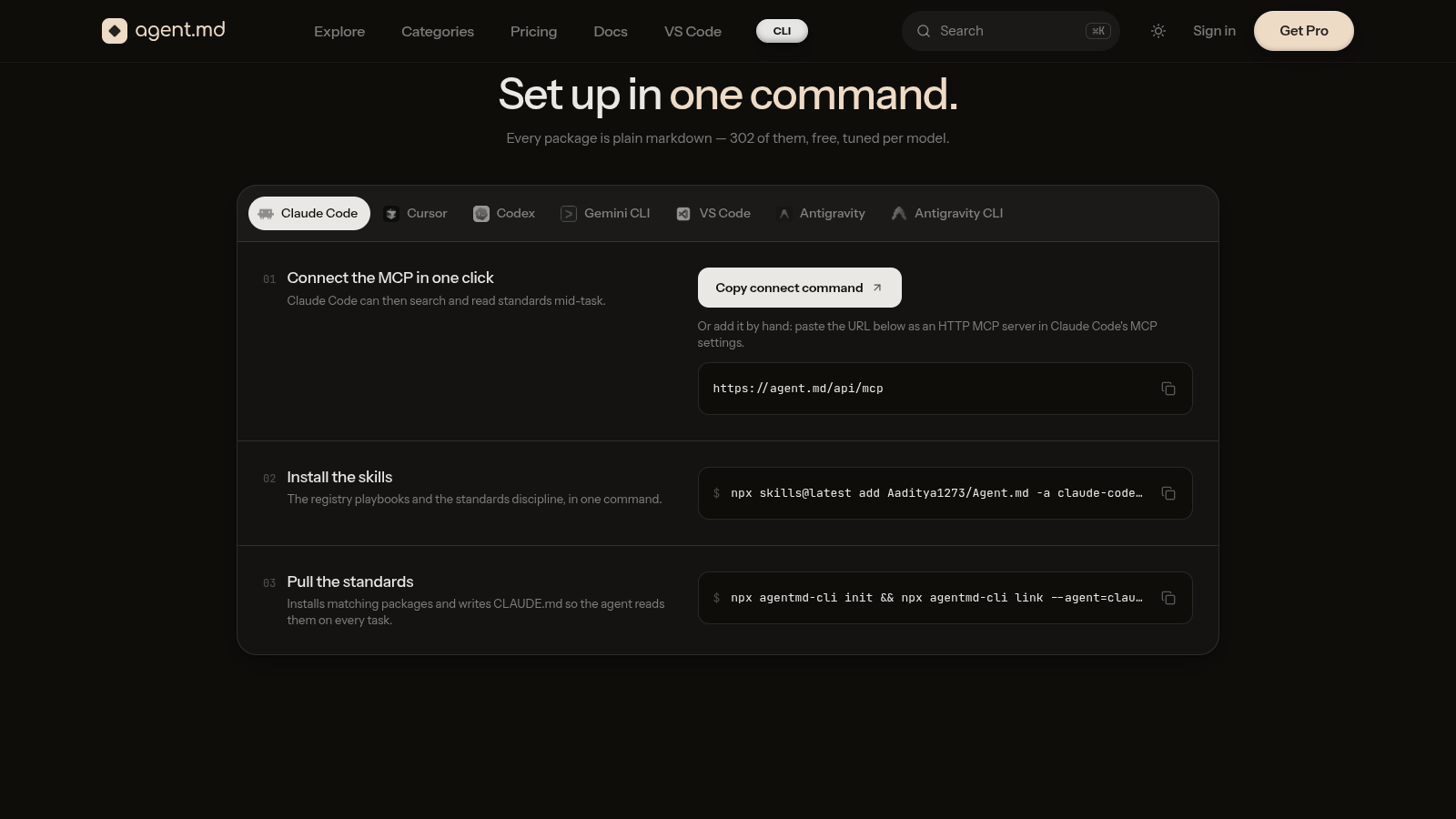
npx skills@latest add Aaditya1273/Agent.md -a claude-code -a cursor -yMCP server. Search and read standards mid-task:
claude mcp add --transport http agentmd https://agentmd.pages.dev/api/mcp     # Claude Code
codex  mcp add agentmd --url https://agentmd.pages.dev/api/mcp                # Codex
gemini mcp add --transport http agentmd https://agentmd.pages.dev/api/mcp     # Gemini CLI
Cursor and VS Code: one click at agentmd.tech/connect.
The registry is separate from the security product. Standards are optional: on demand, and installed only with init --presets. Plain init attaches the checks and the guard and installs no standards.
This repository is the registry: plain markdown, written once in _canonical/ and generated for 11 model families (Claude, OpenAI, Gemini, DeepSeek, Grok, Qwen, Kimi, GLM, MiniMax, Mistral, Sarvam): 308 standards in 21 categories for Claude, 304 for each other family.
| Category | Examples |
|---|---|
| Security | owasp, jwt, oauth, sql-injection, xss, csrf, cors, secret-management, passwords, headers |
| Backend | express, nextjs, fastapi, django, flask, pydantic, python-async, go-http, go-errors, go-concurrency |
| Database | postgres, mysql, mongodb, prisma, sqlalchemy, indexes, migration, schema-design |
| Frontend | react, nextjs, typescript, tailwind, hooks, server-components, routing, forms, state-management |
| API | rest, graphql, pagination, versioning, rate-limiting, webhooks, open-api |
| Testing | unit, integration, e2e, pytest, go-testing, load, accessibility, test-strategy |
| Performance · DevOps · System Design | caching, bundle-size, docker, kubernetes, github-actions, cicd, microservices, event-driven |
| Design | 74 brand design languages: apple, stripe, linear, vercel, airbnb, spotify… |
| Motion (Claude) | lumen, hanami, hanko-reel, truecut: launch films built in code, from story to render |
| + AI, Review, Documentation, Checklists, Startup, Business, Open Source, Templates, Community, Research |
npx activate-agentmd search "rate limiting"
npx activate-agentmd info Security/jwt
npx activate-agentmd install Database/          # a whole category
npx activate-agentmd install claude/Motion/lumen # make a launch film with Claude
Browse with logos and search at agentmd.tech. Full CLI reference: docs/cli.md.
- Patterns, not verdicts.
lintis deterministic pattern matching; a pass is a floor. Every gap is listed per rule in docs/KNOWN-LIMITS.md. - Where rules are enforced.
enforcecompiles "never" lines into Claude Codepermissions.denyand Codex rules (trusted projects); for Gemini CLI it prints a policy for~/.gemini/policies, which Gemini does not yet load from a repo; Cursor has no repo-level deny list.pinis Claude Code only. - Where the runtime guard blocks. Claude Code, Gemini CLI and Cursor, through their hooks; the Gemini CLI hook was verified in a live session (gemini-cli 0.66.0, 2 Nov 2026), and the Cursor hook is checked against Cursor's documented payload, not yet in a live session. On Codex it is an advisory MCP check that
initdoes not attach. Its destructive and exfiltration checks match text, so a command built at run time, or a script written and then run, can pass. - Look-alikes offline are a short list. The offline check knows widely installed names and the project's manifests; a squat of anything else needs the online install gate.
- Memory only escalates. It turns a third attempt at an action already refused twice into a block, and never refuses anything else. Per-project memory needs no service. The optional shared service has no authentication, so the documented
docker runpublishes it on 127.0.0.1 only; keep it there or on a private network. If it is unreachable, the guard pauses as it would without memory and says so. - Receipts prove the key, not the process. The guard's key is readable by the machine's own user, so a local receipt proves which key signed, not that only the guard could use it. For receipts that must hold against that user, sign in CI with a key from a secret.
learn --pris checked against a local git origin, not yet a real GitHub repository.- The broker is verified on AWS and on Linux. AWS was checked on a real account, and the GCP and Azure paths under bubblewrap on Linux; real GitHub App, GCP and Azure accounts, macOS and Windows are covered by unit tests, not yet run live. On Windows the run gets a fresh profile, not a filesystem sandbox.
guardruns where the agent has a command hook. Installs typed by hand are caught at review time byinstall-sourceandpackage-swap.- Bundles are a CI and review gate, not runtime enforcement. They stop an unapproved file from merging unseen.
Questions? Ask in the Agent.md Discord: about a standard, the CLI, or whether an idea is worth a pull request. No question is too small.
Standards are plain markdown in _canonical/<Category>/<name>.md. The bar: imperative, specific, short wrong/right code pairs, an anti-patterns table and a checklist, and evidence that the standard changes what a model writes (agentmd test --baseline prints it). A standard that doesn't change the output isn't a standard; it's a file.
Hacktoberfest 2026: the open issues are scoped, markdown-only and need no build: new standards for Vue, Svelte, Angular, Rust, NestJS, Fastify and Java; upgrades of legacy packages; verification against React 19, Next 16, Prisma 7 and Tailwind 4. See CONTRIBUTING.md.
| Status | Item |
|---|---|
| ✅ Shipping | init (attach) · demo · runtime guard on Claude Code, Gemini CLI and Cursor (pauses irreversible calls, refuses what your files forbid, look-alike installs paused offline, signed refusals) · memory · one receipt format and verify · broker (AWS, GitHub App, GCP, Azure) · digest · learn from corrections and refusals, learn --pr · enforce for Claude Code and Codex · lint with 26 checks (+ SARIF, and in the browser at /inspect) · audit · guard · pin · cost --budget · sbom · version pins with 15 checks · signed context bundles · review --fast · test --baseline · on-demand rules for 5 agents · MCP server · Agent Skills · 300+ standards · Motion category (Claude) |
| 🔬 Measuring | The effect of every pin (old-API rate with vs. without), on more than one model before anything is published · the runtime guard in live Gemini CLI and Cursor sessions · the broker on real GitHub App, GCP and Azure accounts, macOS and Windows |
| 🔨 Next | the runtime guard blocking on Codex · pin for Codex, Cursor and Gemini CLI · skill freshness against upstream releases · MCP capability scope · VS Code extension on the Marketplace · more Motion standards · library authors publishing their own pins |
| 💭 Considering | Signed-bundle format proposed to the AGENTS.md specification · a public scoreboard of agent-file health across popular repos |
Is this a replacement for CLAUDE.md / AGENTS.md / Cursor rules?
No. Those are file formats. Agent.md checks what's in them, keeps them true to your code, and turns the rules into controls.
Isn't a linter a one-time fix?
The files are read on every prompt and change on every PR. The runtime guard runs on every tool call, pin on every compaction, guard on every install, ci on every pull request, learn whenever you repeat yourself or the guard keeps refusing the same thing, lint whenever a dependency or path moves.
Does it paste 30 standards into every prompt? No. Only version pins are always on. Standards load on demand, when the agent opens a matching file.
Does lint need Agent.md installed in the repo?
No. npx activate-agentmd lint works on any repository with any agent instruction files.
What does the runtime guard do when the agent tries something irreversible?
It pauses the call and tells the agent why; a person approves it with agentmd allow or it does not run. A call your AGENTS.md or CLAUDE.md forbids is refused, citing the line. Every refusal is signed, so anyone can check it later with verify.
Will it slow my agent down?
The runtime guard's hook takes 3.8–4.9 ms at p50 end to end (Linux x86_64, 12 CPUs), and the install gate about 39 ms; pin stays inside the token budget you give it.
Does anything leave my machine?
init, install, link, pins, lint, pin, enforce, learn, memory, digest, cost, sbom, bundle, review --fast and the runtime guard run locally. lint --online and guard ask npm, PyPI and OSV about package names only. verify asks GitHub for a signer's public signing keys unless --offline. broker asks AWS, GitHub, GCP or Azure for the short-lived token, and learn --pr pushes a branch to your own remote. review (model mode), extract and test send the diff or evidence to the Anthropic API under your own key. Anonymous usage counters are off by default and opt-in (agentmd telemetry).
Does a pin actually change what a model writes? That is the right question, and it is being measured rather than assumed. Pins matter most when the model's training predates the version you run. Results are published once they repeat on a second model.
MIT. Use it anywhere, including commercial projects, no attribution required.
agentmd.tech · npm · X @agent_dot_md
If Agent.md saved you a debugging session, a ⭐ helps the next person find it.